
Stand-up versus improv: Let's generalise wildly
The lone, distant, marketable genius versus a community of silly nerds

A thing that’s working for me: Saving a new draft every day
Any time I work on a writing project that will take more than a single day to complete, I have multiple drafts. I simply save them as TITLE NEW DATE. I do this for every single new date I work on a project.
So I know that I’ve worked on my 15-minute sitcom script Absolute Witches on 18 different occasions (sometimes for minutes, sometimes for hours) because there are 18 different drafts in the folder.
Multiple drafts make it so much easier to kill my darlings. I’m not deleting a scene; I’m merely leaving that in an earlier draft! I can still come back to it. It mitigates decision paralysis and allows me to stay in ‘writer mode’ rather than ‘editor mode’. This is a lie I tell myself to make it easier to cut lines which I love but do not need.
But sometimes that lie turns out not to be a lie. Sometimes other changes I’ve made suddenly make that old scene make sense again. And I don’t have to try to remember what I wrote three months ago – it’s right there in the folder.
A thing I’m working on: Submitting sketches to the Luke Pitman open call
Luke Pitman is an actor seeking original sketches for a filmed comedy project. Writers can submit up to five sketches, and there’s a £200 fee per sketch used.
Paid sketch opportunities are few and far between so I imagine there will be a lot of interest in this opportunity. And hopefully even more now that I have advertised it further. I am not great at capitalism.
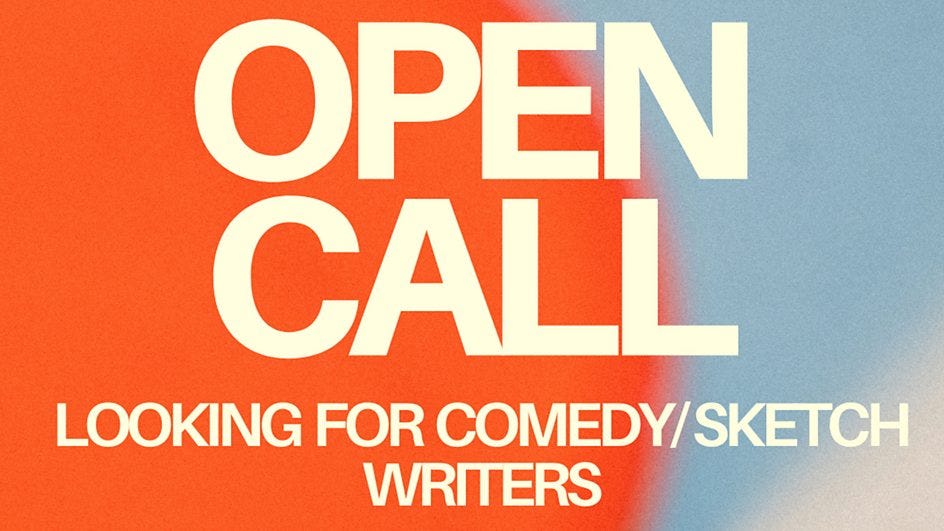
One of the nice things about writing regularly for Next Level Sketch and DMs are Open is that, without a lot of effort, I find myself with a sizeable back catalogue to choose from. I don’t have to write five new sketches from scratch (not that anyone has to – five is the maximum, not the requirement) – but instead I can select my favourites and adapt without a huge amount of effort. Thanks, past me!
A thing I’m enjoying: How to beat the gamification of our lives with C. Thi Ngyugen
This is an episode of the podcast Factually! With Adam Conover, which, full disclosure, I’ve never listened to before now. Every other episode might be horrible and everyone involved might be terrible for all I know, but this particular episode – as recommended by My fellow Next Level Sketch-er Alex Lubetkin – is so interesting.
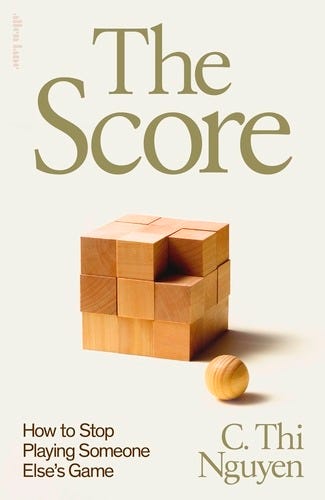
C. Thi Nguyen is a philosopher who writes about gamification. Why do rules and scores and winning feel so good when it comes to games, but feel so crummy when applied to real life? We all know the downsides of caring about ‘likes’ to our Substack posts, but what’s their utility? What quantitative measures can we apply to art in the first place? And what political systems are behind this?
(Spoiler alert: capitalism.)
Nguyen’s analysis goes way beyond the usual surface-level discussion of engagement stats = bad, doing art for yourself = good. Here’s one quote that really resonated with me; it encapsulates a lot of why improv brings me so much more joy than stand-up:
“All the arts we think of as High – movies, fiction, painting – is art where you essentially sit on your ass and look at some distant genius do something that is amazing – but they’re distant.
And all the art forms where the right to be creative is distributed and encouraged to the whole community – improv comedy, fan fiction, Dungeons and Dragons, cosplay – are all called Low and geeky.”
So let’s generalise wildly and insultingly about the current state of stand-up versus improv:
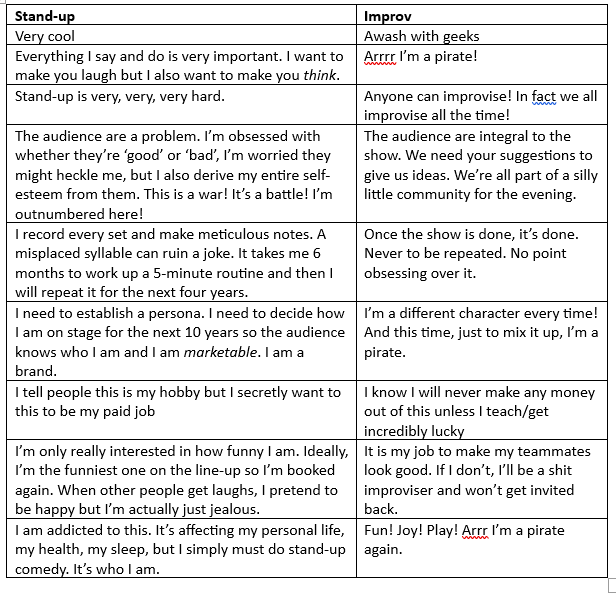
I should caveat this by saying that in the capitalist hellscape in which we find ourselves, the majority of stand-up comedians are also not making any money from their art. But they’re being sold the dream that if they can market themselves as a brand, get enough views on social media with crowd work clips and just repeat their ‘bullet-proof’ sets time after time, they’ll be able to make comedy their career. And that works just enough of the time to get stand-ups to keep doing that.
The whole British comedy industry is a pyramid scheme with about 20 stand-ups making out like bandits, maybe 5% making a living wage and the rest of us fighting over scraps/doing it as a hobby.[1]
There’s an inherent – but not insurmountable - tension between my beliefs about making comedy.
On the one hand, I believe that making comedy is work, and people should be paid fairly for their work.
On the other, I believe that making comedy is play. Anyone can make comedy and a lot of the joy comes from what I have in common with others rather than what sets me apart. And community can’t be easily commodified.
The bridge between the two is that economic security gives me the safety in which to play. It’s exponentially harder to try new things, muck about and do what you love if you’re worried about you won’t make this month’s rent. The Starving Artist is a scam.
Did I do the thing to build connections from before? Yes!
I emailed an agent about representing me!
Here’s my great and terrible fear: my short, polite email will have annoyed the agent beyond belief. ‘Who does she think she is?’ they’ll mutter to themselves, printing my email only so they can have the visceral satisfaction of shredding it. I’ll be blacklisted from the agency. Scratch that – all agencies. They’ll pull a photo of me from social media – one where I look particularly gormless – and tack it to the noticeboard so they can Sharpie the word ‘NO’ over my face and give me Devil horns.
(The good thing about writing down your irrational fears is that their ridiculousness comes across loud and clear. No-one uses a printer unless they have to.)
That’s the fear. But what’s the most likely outcome? They’ll skim-read my email and never give me a second thought. Phew.
A thing I’m doing to build connections: Writing an email to another agent
On the off-chance that the aforementioned single email doesn’t get me immediate representation, I should probably get in touch with multiple agents. So now I’ve cleared the first hurdle of the initial email, let’s clear the second. And the third and the fourth and the fifth and the....
[1] Another wild generalisation based on my own biased observations and no attempt at statistical evidence gathering.
"Multiple drafts make it so much easier to kill my darlings. I’m not deleting a scene; I’m merely leaving that in an earlier draft! I can still come back to it." Good call! I'll give that a go myself.
"The whole British comedy industry is a pyramid scheme with about 20 stand-ups making out like bandits, maybe 5% making a living wage and the rest of us fighting over scraps/doing it as a hobby." Bah. Sounds about right. You get these colossal winner-takes-all effects. Just occurred to me now: I'd be genuinely fascinated in interviewing not just comedians themselves, but comedians' agents and various PR-mooks, on their thoughts and/or efforts in long-term comedian career work, on increasing the marketing of this ~5% to encourage greater numbers to become stadium-fillers, and on boosting open-mic night participants into the 5%.